

usrp-users@lists.ettus.com
Discussion and technical support related to USRP, UHD, RFNoC
View all threadsSC8 Wireformat

Hello all,
I'm recording RF signal at 1.5 GHz using usrp2 with wbx daughterboard of fixed BW of 40 MHz; since I'm interested to capture the whole BW, I set the over-the-wire format to sc8 to be able to have 50 MSps rate; as example rx_samples_to_file suggests, there is no "byte" or "char" format to store 8 bit IQ samples; now, if I use "short" type and try to read my binary file using matlab, for example, and use the same "int16" format as I was doing for SC16 wireformat, i.e interpreting it as I1, Q1, I2, Q2 ..... using "int16" reading format, the spectrum looks not the way it should. I know it also has to do with the host cpu format which in my case it is 64 bit processor but I don't know how to manage the transformation between the host and the packet router. Can some please explain how it works and if possible how to interpret the data on platform other than uhd? it is also appreciated if explain how I could store using 8 bit format so that the file size be reduced to half.
Thanks,

On 06/22/2018 05:43 PM, Farhad Mirkazemi via USRP-users wrote:
Hello all,
I'm recording RF signal at 1.5 GHz using usrp2 with wbx daughterboard
of fixed BW of 40 MHz; since I'm interested to capture the whole BW, I
set the over-the-wire format to sc8 to be able to have 50 MSps rate;
as example rx_samples_to_file suggests, there is no "byte" or "char"
format to store 8 bit IQ samples; now, if I use "short" type and try
to read my binary file using matlab, for example, and use the same
"int16" format as I was doing for SC16 wireformat, i.e interpreting it
as I1, Q1, I2, Q2 ..... using "int16" reading format, the spectrum
looks not the way it should. I know it also has to do with the host
cpu format which in my case it is 64 bit processor but I don't know
how to manage the transformation between the host and the packet
router. Can some please explain how it works and if possible how to
interpret the data on platform other than uhd? it is also appreciated
if explain how I could store using 8 bit format so that the file size
be reduced to half.
Thanks,
You may need to tweak the dynamic range in the device arguments, using
"peak=0.01" or even "peak=0.001", depending on hows strong your
signal is.
Also, could you describe what you mean by "not what it should be" ??
That's a little vague.
Hi all,
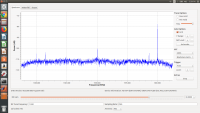
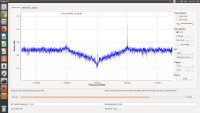
I attached the two spectrum snapshots with no antenna connected (which means what I'm seeing is just pure noise?)to usrp2 setting the center frequency at 1590 MHz, one using sc16, fs 25 MHz and the other sc8 wireformat fs 50 MHz; regardless of the spike at 1600 MHz (10 MHz off the fc) which I don't know why it shows up on both spectrum (I can interpret the spike at the center frequency as dc component but don't know about this one); so it looks like for the sc8 the spectrum has been folded around center frequency where for sc16 wireformat it looks normal. can you please explain why is that and how to fix this? Thanks,
On Friday, June 22, 2018, 5:52:23 PM EDT, Marcus D. Leech via USRP-users <usrp-users@lists.ettus.com> wrote:
On 06/22/2018 05:43 PM, Farhad Mirkazemi via USRP-users wrote:
Hello all,
I'm recording RF signal at 1.5 GHz using usrp2 with wbx daughterboard of fixed BW of 40 MHz; since I'm interested to capture the whole BW, I set the over-the-wire format to sc8 to be able to have 50 MSps rate; as example rx_samples_to_file suggests, there is no "byte" or "char" format to store 8 bit IQ samples; now, if I use "short" type and try to read my binary file using matlab, for example, and use the same "int16" format as I was doing for SC16 wireformat, i.e interpreting it as I1, Q1, I2, Q2 ..... using "int16" reading format, the spectrum looks not the way it should. I know it also has to do with the host cpu format which in my case it is 64 bit processor but I don't know how to manage the transformation between the host and the packet router. Can some please explain how it works and if possible how to interpret the data on platform other than uhd? it is also appreciated if explain how I could store using 8 bit format so that the file size be reduced to half.
Thanks,
You may need to tweak the dynamic range in the device arguments, using "peak=0.01" or even "peak=0.001", depending on hows strong your
signal is.
Also, could you describe what you mean by "not what it should be" ?? That's a little vague.
USRP-users mailing list
USRP-users@lists.ettus.com
http://lists.ettus.com/mailman/listinfo/usrp-users_lists.ettus.com

On a USRP2 thats a harmonic of the on-board 100MHz clock. One excellent way to deduce when you are dealing with a spur thats LO related is to use offset tuning to move the LO relative to the center of your band of interest.
See: https://files.ettus.com/manual/structuhd_1_1tune__request__t.html https://files.ettus.com/manual/structuhd_1_1tune__request__t.html
On Jun 25, 2018, at 3:15 PM, Farhad Mirkazemi via USRP-users usrp-users@lists.ettus.com wrote:
Hi all,
I attached the two spectrum snapshots with no antenna connected (which means what I'm seeing is just pure noise?)to usrp2 setting the center frequency at 1590 MHz, one using sc16, fs 25 MHz and the other sc8 wireformat fs 50 MHz; regardless of the spike at 1600 MHz (10 MHz off the fc) which I don't know why it shows up on both spectrum (I can interpret the spike at the center frequency as dc component but don't know about this one); so it looks like for the sc8 the spectrum has been folded around center frequency where for sc16 wireformat it looks normal. can you please explain why is that and how to fix this?
Thanks,
On Friday, June 22, 2018, 5:52:23 PM EDT, Marcus D. Leech via USRP-users usrp-users@lists.ettus.com wrote:
On 06/22/2018 05:43 PM, Farhad Mirkazemi via USRP-users wrote:
Hello all,
I'm recording RF signal at 1.5 GHz using usrp2 with wbx daughterboard of fixed BW of 40 MHz; since I'm interested to capture the whole BW, I set the over-the-wire format to sc8 to be able to have 50 MSps rate; as example rx_samples_to_file suggests, there is no "byte" or "char" format to store 8 bit IQ samples; now, if I use "short" type and try to read my binary file using matlab, for example, and use the same "int16" format as I was doing for SC16 wireformat, i.e interpreting it as I1, Q1, I2, Q2 ..... using "int16" reading format, the spectrum looks not the way it should. I know it also has to do with the host cpu format which in my case it is 64 bit processor but I don't know how to manage the transformation between the host and the packet router. Can some please explain how it works and if possible how to interpret the data on platform other than uhd? it is also appreciated if explain how I could store using 8 bit format so that the file size be reduced to half.
Thanks,
You may need to tweak the dynamic range in the device arguments, using "peak=0.01" or even "peak=0.001", depending on hows strong your
signal is.
Also, could you describe what you mean by "not what it should be" ?? That's a little vague.
USRP-users mailing list
USRP-users@lists.ettus.com mailto:USRP-users@lists.ettus.com
http://lists.ettus.com/mailman/listinfo/usrp-users_lists.ettus.com http://lists.ettus.com/mailman/listinfo/usrp-users_lists.ettus.com
<Screenshot from 2018-06-25 17-58-12.png><Screenshot from 2018-06-25 18-00-34.png>_______________________________________________
USRP-users mailing list
USRP-users@lists.ettus.com
http://lists.ettus.com/mailman/listinfo/usrp-users_lists.ettus.com
Thanks Ian for your answer; but my main question still remains unanswered which is why with different wire format sc8 and sc16 the spectrum is different? How may I interpret this?
Thanks,
On Jun 25, 2018, at 9:44 PM, Ian Buckley ianb@ionconcepts.com wrote:
On a USRP2 thats a harmonic of the on-board 100MHz clock. One excellent way to deduce when you are dealing with a spur thats LO related is to use offset tuning to move the LO relative to the center of your band of interest.
See: https://files.ettus.com/manual/structuhd_1_1tune__request__t.html
On Jun 25, 2018, at 3:15 PM, Farhad Mirkazemi via USRP-users usrp-users@lists.ettus.com wrote:
Hi all,
I attached the two spectrum snapshots with no antenna connected (which means what I'm seeing is just pure noise?)to usrp2 setting the center frequency at 1590 MHz, one using sc16, fs 25 MHz and the other sc8 wireformat fs 50 MHz; regardless of the spike at 1600 MHz (10 MHz off the fc) which I don't know why it shows up on both spectrum (I can interpret the spike at the center frequency as dc component but don't know about this one); so it looks like for the sc8 the spectrum has been folded around center frequency where for sc16 wireformat it looks normal. can you please explain why is that and how to fix this?
Thanks,
On Friday, June 22, 2018, 5:52:23 PM EDT, Marcus D. Leech via USRP-users usrp-users@lists.ettus.com wrote:
On 06/22/2018 05:43 PM, Farhad Mirkazemi via USRP-users wrote:
Hello all,
I'm recording RF signal at 1.5 GHz using usrp2 with wbx daughterboard of fixed BW of 40 MHz; since I'm interested to capture the whole BW, I set the over-the-wire format to sc8 to be able to have 50 MSps rate; as example rx_samples_to_file suggests, there is no "byte" or "char" format to store 8 bit IQ samples; now, if I use "short" type and try to read my binary file using matlab, for example, and use the same "int16" format as I was doing for SC16 wireformat, i.e interpreting it as I1, Q1, I2, Q2 ..... using "int16" reading format, the spectrum looks not the way it should. I know it also has to do with the host cpu format which in my case it is 64 bit processor but I don't know how to manage the transformation between the host and the packet router. Can some please explain how it works and if possible how to interpret the data on platform other than uhd? it is also appreciated if explain how I could store using 8 bit format so that the file size be reduced to half.
Thanks,
You may need to tweak the dynamic range in the device arguments, using "peak=0.01" or even "peak=0.001", depending on hows strong your
signal is.
Also, could you describe what you mean by "not what it should be" ?? That's a little vague.
USRP-users mailing list
USRP-users@lists.ettus.com
http://lists.ettus.com/mailman/listinfo/usrp-users_lists.ettus.com
<Screenshot from 2018-06-25 17-58-12.png><Screenshot from 2018-06-25 18-00-34.png>_______________________________________________
USRP-users mailing list
USRP-users@lists.ettus.com
http://lists.ettus.com/mailman/listinfo/usrp-users_lists.ettus.com

Just speculating, but I wonder if what you're seeing is a result of
quantization error...
On Mon, Jun 25, 2018 at 11:55 PM Farhad via USRP-users <
usrp-users@lists.ettus.com> wrote:
Thanks Ian for your answer; but my main question still remains unanswered
which is why with different wire format sc8 and sc16 the spectrum is
different? How may I interpret this?
Thanks,
On Jun 25, 2018, at 9:44 PM, Ian Buckley ianb@ionconcepts.com wrote:
On a USRP2 thats a harmonic of the on-board 100MHz clock. One excellent
way to deduce when you are dealing with a spur thats LO related is to use
offset tuning to move the LO relative to the center of your band of
interest.
See: https://files.ettus.com/manual/structuhd_1_1tune__request__t.html
On Jun 25, 2018, at 3:15 PM, Farhad Mirkazemi via USRP-users <
usrp-users@lists.ettus.com> wrote:
Hi all,
I attached the two spectrum snapshots with no antenna connected (which
means what I'm seeing is just pure noise?)to usrp2 setting the center
frequency at 1590 MHz, one using sc16, fs 25 MHz and the other sc8
wireformat fs 50 MHz; regardless of the spike at 1600 MHz (10 MHz off the
fc) which I don't know why it shows up on both spectrum (I can interpret
the spike at the center frequency as dc component but don't know about this
one); so it looks like for the sc8 the spectrum has been folded around
center frequency where for sc16 wireformat it looks normal. can you please
explain why is that and how to fix this?
Thanks,
On Friday, June 22, 2018, 5:52:23 PM EDT, Marcus D. Leech via USRP-users <
usrp-users@lists.ettus.com> wrote:
On 06/22/2018 05:43 PM, Farhad Mirkazemi via USRP-users wrote:
Hello all,
I'm recording RF signal at 1.5 GHz using usrp2 with wbx daughterboard of
fixed BW of 40 MHz; since I'm interested to capture the whole BW, I set the
over-the-wire format to sc8 to be able to have 50 MSps rate; as example
rx_samples_to_file suggests, there is no "byte" or "char" format to store 8
bit IQ samples; now, if I use "short" type and try to read my binary file
using matlab, for example, and use the same "int16" format as I was doing
for SC16 wireformat, i.e interpreting it as I1, Q1, I2, Q2 ..... using
"int16" reading format, the spectrum looks not the way it should. I know
it also has to do with the host cpu format which in my case it is 64 bit
processor but I don't know how to manage the transformation between the
host and the packet router. Can some please explain how it works and if
possible how to interpret the data on platform other than uhd? it is also
appreciated if explain how I could store using 8 bit format so that the
file size be reduced to half.
Thanks,
You may need to tweak the dynamic range in the device arguments, using
"peak=0.01" or even "peak=0.001", depending on hows strong your
signal is.
Also, could you describe what you mean by "not what it should be" ??
That's a little vague.
USRP-users mailing list
USRP-users@lists.ettus.com
http://lists.ettus.com/mailman/listinfo/usrp-users_lists.ettus.com
<Screenshot from 2018-06-25 17-58-12.png><Screenshot from 2018-06-25
18-00-34.png>_______________________________________________
USRP-users mailing list
USRP-users@lists.ettus.com
http://lists.ettus.com/mailman/listinfo/usrp-users_lists.ettus.com
USRP-users mailing list
USRP-users@lists.ettus.com
http://lists.ettus.com/mailman/listinfo/usrp-users_lists.ettus.com
--
Very Respectfully,
Dan CaJacob