

usrp-users@lists.ettus.com

Discussion and technical support related to USRP, UHD, RFNoC

View all threads

TX Image rejection B210

SH
Sebastian Held
Mon, Mar 30, 2015 6:50 AM

Hi,

I'm currently investigating a problem with my OFDM modulated signals. To
understand, why the spectrum mask is violated, I first checked the basic
TX parameters. The B210 is connected to a R&S FSQ26 via a 20 dB attenuator.

I use the examples provided with the UHD-release_003_008_002-10-ge067c45:
./tx_waveforms --args="master_clock_rate=20e6" --rate 20000000
--freq=5900000000 --gain=80 --wave-type SINE --ref=gpsdo --int-n
--wave-freq=1000000

This command results in an expected tone at 5.9 GHz + 1 MHz (approx. -29
dBm) and its image at 5.9 GHz - 1 MHz. The problem is: the image power
is very large: only 26 dB below the wanted 5.901 GHz tone. From the
AD9361 data sheet I would expect a suppression of at least 45 dB.

To continue to solve my original problem (OFDM spectrum) I first need to
understand, why I get such a large image.
Can I use this example to evaluate the TX image? Any pointers?

Regards,
Sebastian

--
Sebastian Held (Dipl.-Ing.)
IMST GmbH
Software Engineer
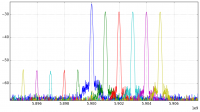
Hi, I'm currently investigating a problem with my OFDM modulated signals. To understand, why the spectrum mask is violated, I first checked the basic TX parameters. The B210 is connected to a R&S FSQ26 via a 20 dB attenuator. I use the examples provided with the UHD-release_003_008_002-10-ge067c45: ./tx_waveforms --args="master_clock_rate=20e6" --rate 20000000 --freq=5900000000 --gain=80 --wave-type SINE --ref=gpsdo --int-n --wave-freq=1000000 This command results in an expected tone at 5.9 GHz + 1 MHz (approx. -29 dBm) and its image at 5.9 GHz - 1 MHz. The problem is: the image power is very large: only 26 dB below the wanted 5.901 GHz tone. From the AD9361 data sheet I would expect a suppression of at least 45 dB. To continue to solve my original problem (OFDM spectrum) I first need to understand, why I get such a large image. Can I use this example to evaluate the TX image? Any pointers? Regards, Sebastian -- Sebastian Held (Dipl.-Ing.) IMST GmbH Software Engineer
MB
Martin Braun
Mon, Mar 30, 2015 4:46 PM

Sebastian,

what happens when you turn down the gain (e.g. to 70 dB)?

M

On 29.03.2015 23:50, Sebastian Held via USRP-users wrote:

Hi,

I'm currently investigating a problem with my OFDM modulated signals. To
understand, why the spectrum mask is violated, I first checked the basic
TX parameters. The B210 is connected to a R&S FSQ26 via a 20 dB attenuator.

I use the examples provided with the UHD-release_003_008_002-10-ge067c45:
./tx_waveforms --args="master_clock_rate=20e6" --rate 20000000
--freq=5900000000 --gain=80 --wave-type SINE --ref=gpsdo --int-n
--wave-freq=1000000

This command results in an expected tone at 5.9 GHz + 1 MHz (approx. -29
dBm) and its image at 5.9 GHz - 1 MHz. The problem is: the image power
is very large: only 26 dB below the wanted 5.901 GHz tone. From the
AD9361 data sheet I would expect a suppression of at least 45 dB.

To continue to solve my original problem (OFDM spectrum) I first need to
understand, why I get such a large image.
Can I use this example to evaluate the TX image? Any pointers?

Regards,
Sebastian


USRP-users mailing list
USRP-users@lists.ettus.com
http://lists.ettus.com/mailman/listinfo/usrp-users_lists.ettus.com

Sebastian, what happens when you turn down the gain (e.g. to 70 dB)? M On 29.03.2015 23:50, Sebastian Held via USRP-users wrote: > Hi, > > I'm currently investigating a problem with my OFDM modulated signals. To > understand, why the spectrum mask is violated, I first checked the basic > TX parameters. The B210 is connected to a R&S FSQ26 via a 20 dB attenuator. > > I use the examples provided with the UHD-release_003_008_002-10-ge067c45: > ./tx_waveforms --args="master_clock_rate=20e6" --rate 20000000 > --freq=5900000000 --gain=80 --wave-type SINE --ref=gpsdo --int-n > --wave-freq=1000000 > > This command results in an expected tone at 5.9 GHz + 1 MHz (approx. -29 > dBm) and its image at 5.9 GHz - 1 MHz. The problem is: the image power > is very large: only 26 dB below the wanted 5.901 GHz tone. From the > AD9361 data sheet I would expect a suppression of at least 45 dB. > > To continue to solve my original problem (OFDM spectrum) I first need to > understand, why I get such a large image. > Can I use this example to evaluate the TX image? Any pointers? > > Regards, > Sebastian > > > > _______________________________________________ > USRP-users mailing list > USRP-users@lists.ettus.com > http://lists.ettus.com/mailman/listinfo/usrp-users_lists.ettus.com >
SH
Sebastian Held
Tue, Mar 31, 2015 7:51 AM

forgot to include the list.

Dear Martin,

please see attached figure. Reducing the gain acts on both the wanted
and unwanted signal in the same manner.

Sebastian

Am 30.03.2015 um 18:46 schrieb Martin Braun via USRP-users:

Sebastian,

what happens when you turn down the gain (e.g. to 70 dB)?

M

On 29.03.2015 23:50, Sebastian Held via USRP-users wrote:

Hi,

I'm currently investigating a problem with my OFDM modulated signals. To
understand, why the spectrum mask is violated, I first checked the basic
TX parameters. The B210 is connected to a R&S FSQ26 via a 20 dB
attenuator.

I use the examples provided with the
UHD-release_003_008_002-10-ge067c45:
./tx_waveforms --args="master_clock_rate=20e6" --rate 20000000
--freq=5900000000 --gain=80 --wave-type SINE --ref=gpsdo --int-n
--wave-freq=1000000

This command results in an expected tone at 5.9 GHz + 1 MHz (approx. -29
dBm) and its image at 5.9 GHz - 1 MHz. The problem is: the image power
is very large: only 26 dB below the wanted 5.901 GHz tone. From the
AD9361 data sheet I would expect a suppression of at least 45 dB.

To continue to solve my original problem (OFDM spectrum) I first need to
understand, why I get such a large image.
Can I use this example to evaluate the TX image? Any pointers?

Regards,
Sebastian


USRP-users mailing list
USRP-users@lists.ettus.com
http://lists.ettus.com/mailman/listinfo/usrp-users_lists.ettus.com

--
Sebastian Held (Dipl.-Ing.)
IMST GmbH
Software Engineer
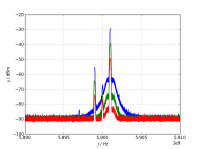
forgot to include the list. Dear Martin, please see attached figure. Reducing the gain acts on both the wanted and unwanted signal in the same manner. Sebastian Am 30.03.2015 um 18:46 schrieb Martin Braun via USRP-users: > Sebastian, > > what happens when you turn down the gain (e.g. to 70 dB)? > > M > > On 29.03.2015 23:50, Sebastian Held via USRP-users wrote: >> Hi, >> >> I'm currently investigating a problem with my OFDM modulated signals. To >> understand, why the spectrum mask is violated, I first checked the basic >> TX parameters. The B210 is connected to a R&S FSQ26 via a 20 dB >> attenuator. >> >> I use the examples provided with the >> UHD-release_003_008_002-10-ge067c45: >> ./tx_waveforms --args="master_clock_rate=20e6" --rate 20000000 >> --freq=5900000000 --gain=80 --wave-type SINE --ref=gpsdo --int-n >> --wave-freq=1000000 >> >> This command results in an expected tone at 5.9 GHz + 1 MHz (approx. -29 >> dBm) and its image at 5.9 GHz - 1 MHz. The problem is: the image power >> is very large: only 26 dB below the wanted 5.901 GHz tone. From the >> AD9361 data sheet I would expect a suppression of at least 45 dB. >> >> To continue to solve my original problem (OFDM spectrum) I first need to >> understand, why I get such a large image. >> Can I use this example to evaluate the TX image? Any pointers? >> >> Regards, >> Sebastian >> >> >> >> _______________________________________________ >> USRP-users mailing list >> USRP-users@lists.ettus.com >> http://lists.ettus.com/mailman/listinfo/usrp-users_lists.ettus.com >> > > > _______________________________________________ > USRP-users mailing list > USRP-users@lists.ettus.com > http://lists.ettus.com/mailman/listinfo/usrp-users_lists.ettus.com > -- Sebastian Held (Dipl.-Ing.) IMST GmbH Software Engineer
SH
Sebastian Held
Tue, Apr 7, 2015 7:47 AM

Hi,

Any news on this?
I have the same problem with two B210 units.
Either the error is my misunderstanding of RF performance parameters,
the example file cannot be used for this performance evaluation or the
hardware design does not meet the performance of the AD chip (which is
hard to believe).

Any hint what I'm doing wrong?

Regards,
Sebastian

Am 31.03.2015 um 09:51 schrieb Sebastian Held via USRP-users:

forgot to include the list.

Dear Martin,

please see attached figure. Reducing the gain acts on both the wanted
and unwanted signal in the same manner.

Sebastian

Am 30.03.2015 um 18:46 schrieb Martin Braun via USRP-users:

Sebastian,

what happens when you turn down the gain (e.g. to 70 dB)?

M

On 29.03.2015 23:50, Sebastian Held via USRP-users wrote:

Hi,

I'm currently investigating a problem with my OFDM modulated signals. To
understand, why the spectrum mask is violated, I first checked the basic
TX parameters. The B210 is connected to a R&S FSQ26 via a 20 dB
attenuator.

I use the examples provided with the
UHD-release_003_008_002-10-ge067c45:
./tx_waveforms --args="master_clock_rate=20e6" --rate 20000000
--freq=5900000000 --gain=80 --wave-type SINE --ref=gpsdo --int-n
--wave-freq=1000000

This command results in an expected tone at 5.9 GHz + 1 MHz (approx. -29
dBm) and its image at 5.9 GHz - 1 MHz. The problem is: the image power
is very large: only 26 dB below the wanted 5.901 GHz tone. From the
AD9361 data sheet I would expect a suppression of at least 45 dB.

To continue to solve my original problem (OFDM spectrum) I first need to
understand, why I get such a large image.
Can I use this example to evaluate the TX image? Any pointers?

Regards,
Sebastian


USRP-users mailing list
USRP-users@lists.ettus.com
http://lists.ettus.com/mailman/listinfo/usrp-users_lists.ettus.com

--
Sebastian Held (Dipl.-Ing.)
IMST GmbH
Software Engineer

Hi, Any news on this? I have the same problem with two B210 units. Either the error is my misunderstanding of RF performance parameters, the example file cannot be used for this performance evaluation or the hardware design does not meet the performance of the AD chip (which is hard to believe). Any hint what I'm doing wrong? Regards, Sebastian Am 31.03.2015 um 09:51 schrieb Sebastian Held via USRP-users: > forgot to include the list. > > Dear Martin, > > please see attached figure. Reducing the gain acts on both the wanted > and unwanted signal in the same manner. > > Sebastian > > Am 30.03.2015 um 18:46 schrieb Martin Braun via USRP-users: >> Sebastian, >> >> what happens when you turn down the gain (e.g. to 70 dB)? >> >> M >> >> On 29.03.2015 23:50, Sebastian Held via USRP-users wrote: >>> Hi, >>> >>> I'm currently investigating a problem with my OFDM modulated signals. To >>> understand, why the spectrum mask is violated, I first checked the basic >>> TX parameters. The B210 is connected to a R&S FSQ26 via a 20 dB >>> attenuator. >>> >>> I use the examples provided with the >>> UHD-release_003_008_002-10-ge067c45: >>> ./tx_waveforms --args="master_clock_rate=20e6" --rate 20000000 >>> --freq=5900000000 --gain=80 --wave-type SINE --ref=gpsdo --int-n >>> --wave-freq=1000000 >>> >>> This command results in an expected tone at 5.9 GHz + 1 MHz (approx. -29 >>> dBm) and its image at 5.9 GHz - 1 MHz. The problem is: the image power >>> is very large: only 26 dB below the wanted 5.901 GHz tone. From the >>> AD9361 data sheet I would expect a suppression of at least 45 dB. >>> >>> To continue to solve my original problem (OFDM spectrum) I first need to >>> understand, why I get such a large image. >>> Can I use this example to evaluate the TX image? Any pointers? >>> >>> Regards, >>> Sebastian >>> >>> >>> >>> _______________________________________________ >>> USRP-users mailing list >>> USRP-users@lists.ettus.com >>> http://lists.ettus.com/mailman/listinfo/usrp-users_lists.ettus.com >>> >> >> _______________________________________________ >> USRP-users mailing list >> USRP-users@lists.ettus.com >> http://lists.ettus.com/mailman/listinfo/usrp-users_lists.ettus.com >> > > > _______________________________________________ > USRP-users mailing list > USRP-users@lists.ettus.com > http://lists.ettus.com/mailman/listinfo/usrp-users_lists.ettus.com -- Sebastian Held (Dipl.-Ing.) IMST GmbH Software Engineer
SM
Sylvain Munaut
Tue, Apr 7, 2015 8:08 AM

Hi,

Any news on this?
I have the same problem with two B210 units.
Either the error is my misunderstanding of RF performance parameters

Which spec of the AD9361 did you use to come up with your 45 dB
expected suppression ?

Cheers,

Sylvain

Hi, > Any news on this? > I have the same problem with two B210 units. > Either the error is my misunderstanding of RF performance parameters Which spec of the AD9361 did you use to come up with your 45 dB expected suppression ? Cheers, Sylvain
SH
Sebastian Held
Tue, Apr 7, 2015 8:25 AM

Dear Sylvain,

I'm referring to figure 73 in the datasheet "SSB rejection".

Sebastian

Am 07.04.2015 um 10:08 schrieb Sylvain Munaut:

Hi,

Which spec of the AD9361 did you use to come up with your 45 dB
expected suppression ?

Cheers,

Sylvain
Dear Sylvain, I'm referring to figure 73 in the datasheet "SSB rejection". Sebastian Am 07.04.2015 um 10:08 schrieb Sylvain Munaut: > Hi, > > Which spec of the AD9361 did you use to come up with your 45 dB > expected suppression ? > > > Cheers, > > Sylvain >
SH
Sebastian Held
Mon, Apr 13, 2015 9:50 AM

Update:

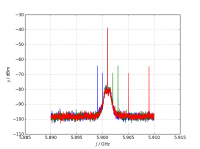
I played around with the LO offset feature and got the following result:

The curves were generated by:
blue: ./tx_waveforms --args="master_clock_rate=10e6" --rate 10000000
--freq=5900000000 --gain=50 --wave-type SINE --ref=gpsdo --int-n
--wave-freq=1000000 --lo_off=0
green: ./tx_waveforms --args="master_clock_rate=10e6" --rate 10000000
--freq=5900000000 --gain=50 --wave-type SINE --ref=gpsdo --int-n
--wave-freq=1000000 --lo_off=2000000
red: ./tx_waveforms --args="master_clock_rate=10e6" --rate 10000000
--freq=5900000000 --gain=50 --wave-type SINE --ref=gpsdo --int-n
--wave-freq=1000000 --lo_off=5000000

Clearly visible: The wanted sine (-38.9 dBm) is offset 1 MHz from 5.9
GHz, which is correct.
The LO is the signal at -69.2 dBm; it moves according to the LO offset
parameter.
The to be rejected sideband is at -64.6 dBm.

The specification of the B210
(http://www.ettus.com/content/files/b200-b210_spec_sheet.pdf) states:
SSB/LO Suppression -35/50 dBc

My measurement:
SSB/LO Suppression -25.7/30.3 dBc

This is far off.
Does anyone have similar problems?
Is there anything I can do to improve these figures?

Sebastian

Am 07.04.2015 um 09:47 schrieb Sebastian Held via USRP-users:

Hi,

Any news on this?
I have the same problem with two B210 units.
Either the error is my misunderstanding of RF performance parameters,
the example file cannot be used for this performance evaluation or the
hardware design does not meet the performance of the AD chip (which is
hard to believe).

Any hint what I'm doing wrong?

Regards,
Sebastian

Am 31.03.2015 um 09:51 schrieb Sebastian Held via USRP-users:

forgot to include the list.

Dear Martin,

please see attached figure. Reducing the gain acts on both the wanted
and unwanted signal in the same manner.

Sebastian

Am 30.03.2015 um 18:46 schrieb Martin Braun via USRP-users:

Sebastian,

what happens when you turn down the gain (e.g. to 70 dB)?

M

On 29.03.2015 23:50, Sebastian Held via USRP-users wrote:

Hi,

I'm currently investigating a problem with my OFDM modulated signals. To
understand, why the spectrum mask is violated, I first checked the basic
TX parameters. The B210 is connected to a R&S FSQ26 via a 20 dB
attenuator.

I use the examples provided with the
UHD-release_003_008_002-10-ge067c45:
./tx_waveforms --args="master_clock_rate=20e6" --rate 20000000
--freq=5900000000 --gain=80 --wave-type SINE --ref=gpsdo --int-n
--wave-freq=1000000

This command results in an expected tone at 5.9 GHz + 1 MHz (approx. -29
dBm) and its image at 5.9 GHz - 1 MHz. The problem is: the image power
is very large: only 26 dB below the wanted 5.901 GHz tone. From the
AD9361 data sheet I would expect a suppression of at least 45 dB.

To continue to solve my original problem (OFDM spectrum) I first need to
understand, why I get such a large image.
Can I use this example to evaluate the TX image? Any pointers?

Regards,
Sebastian


USRP-users mailing list
USRP-users@lists.ettus.com
http://lists.ettus.com/mailman/listinfo/usrp-users_lists.ettus.com

--
Sebastian Held (Dipl.-Ing.)
IMST GmbH
Software Engineer


USRP-users mailing list
USRP-users@lists.ettus.com
http://lists.ettus.com/mailman/listinfo/usrp-users_lists.ettus.com

--
Sebastian Held (Dipl.-Ing.)
IMST GmbH
Software Engineer

Update: I played around with the LO offset feature and got the following result: The curves were generated by: blue: ./tx_waveforms --args="master_clock_rate=10e6" --rate 10000000 --freq=5900000000 --gain=50 --wave-type SINE --ref=gpsdo --int-n --wave-freq=1000000 --lo_off=0 green: ./tx_waveforms --args="master_clock_rate=10e6" --rate 10000000 --freq=5900000000 --gain=50 --wave-type SINE --ref=gpsdo --int-n --wave-freq=1000000 --lo_off=2000000 red: ./tx_waveforms --args="master_clock_rate=10e6" --rate 10000000 --freq=5900000000 --gain=50 --wave-type SINE --ref=gpsdo --int-n --wave-freq=1000000 --lo_off=5000000 Clearly visible: The wanted sine (-38.9 dBm) is offset 1 MHz from 5.9 GHz, which is correct. The LO is the signal at -69.2 dBm; it moves according to the LO offset parameter. The to be rejected sideband is at -64.6 dBm. The specification of the B210 (http://www.ettus.com/content/files/b200-b210_spec_sheet.pdf) states: SSB/LO Suppression -35/50 dBc My measurement: SSB/LO Suppression -25.7/30.3 dBc This is far off. Does anyone have similar problems? Is there anything I can do to improve these figures? Sebastian Am 07.04.2015 um 09:47 schrieb Sebastian Held via USRP-users: > Hi, > > Any news on this? > I have the same problem with two B210 units. > Either the error is my misunderstanding of RF performance parameters, > the example file cannot be used for this performance evaluation or the > hardware design does not meet the performance of the AD chip (which is > hard to believe). > > Any hint what I'm doing wrong? > > Regards, > Sebastian > > Am 31.03.2015 um 09:51 schrieb Sebastian Held via USRP-users: >> forgot to include the list. >> >> Dear Martin, >> >> please see attached figure. Reducing the gain acts on both the wanted >> and unwanted signal in the same manner. >> >> Sebastian >> >> Am 30.03.2015 um 18:46 schrieb Martin Braun via USRP-users: >>> Sebastian, >>> >>> what happens when you turn down the gain (e.g. to 70 dB)? >>> >>> M >>> >>> On 29.03.2015 23:50, Sebastian Held via USRP-users wrote: >>>> Hi, >>>> >>>> I'm currently investigating a problem with my OFDM modulated signals. To >>>> understand, why the spectrum mask is violated, I first checked the basic >>>> TX parameters. The B210 is connected to a R&S FSQ26 via a 20 dB >>>> attenuator. >>>> >>>> I use the examples provided with the >>>> UHD-release_003_008_002-10-ge067c45: >>>> ./tx_waveforms --args="master_clock_rate=20e6" --rate 20000000 >>>> --freq=5900000000 --gain=80 --wave-type SINE --ref=gpsdo --int-n >>>> --wave-freq=1000000 >>>> >>>> This command results in an expected tone at 5.9 GHz + 1 MHz (approx. -29 >>>> dBm) and its image at 5.9 GHz - 1 MHz. The problem is: the image power >>>> is very large: only 26 dB below the wanted 5.901 GHz tone. From the >>>> AD9361 data sheet I would expect a suppression of at least 45 dB. >>>> >>>> To continue to solve my original problem (OFDM spectrum) I first need to >>>> understand, why I get such a large image. >>>> Can I use this example to evaluate the TX image? Any pointers? >>>> >>>> Regards, >>>> Sebastian >>>> >>>> >>>> >>>> _______________________________________________ >>>> USRP-users mailing list >>>> USRP-users@lists.ettus.com >>>> http://lists.ettus.com/mailman/listinfo/usrp-users_lists.ettus.com >>>> >>> _______________________________________________ >>> USRP-users mailing list >>> USRP-users@lists.ettus.com >>> http://lists.ettus.com/mailman/listinfo/usrp-users_lists.ettus.com >>> >> >> >> _______________________________________________ >> USRP-users mailing list >> USRP-users@lists.ettus.com >> http://lists.ettus.com/mailman/listinfo/usrp-users_lists.ettus.com > > -- > Sebastian Held (Dipl.-Ing.) > IMST GmbH > Software Engineer > > > _______________________________________________ > USRP-users mailing list > USRP-users@lists.ettus.com > http://lists.ettus.com/mailman/listinfo/usrp-users_lists.ettus.com -- Sebastian Held (Dipl.-Ing.) IMST GmbH Software Engineer
MD
Marcus D. Leech
Mon, Apr 13, 2015 1:24 PM

On 04/13/2015 05:50 AM, Sebastian Held via USRP-users wrote:

Update:

I played around with the LO offset feature and got the following result:

The curves were generated by:
blue: ./tx_waveforms --args="master_clock_rate=10e6" --rate 10000000
--freq=5900000000 --gain=50 --wave-type SINE --ref=gpsdo --int-n
--wave-freq=1000000 --lo_off=0
green: ./tx_waveforms --args="master_clock_rate=10e6" --rate 10000000
--freq=5900000000 --gain=50 --wave-type SINE --ref=gpsdo --int-n
--wave-freq=1000000 --lo_off=2000000
red: ./tx_waveforms --args="master_clock_rate=10e6" --rate 10000000
--freq=5900000000 --gain=50 --wave-type SINE --ref=gpsdo --int-n
--wave-freq=1000000 --lo_off=5000000

Clearly visible: The wanted sine (-38.9 dBm) is offset 1 MHz from 5.9
GHz, which is correct.
The LO is the signal at -69.2 dBm; it moves according to the LO offset
parameter.
The to be rejected sideband is at -64.6 dBm.

The specification of the B210
(http://www.ettus.com/content/files/b200-b210_spec_sheet.pdf) states:
SSB/LO Suppression -35/50 dBc

My measurement:
SSB/LO Suppression -25.7/30.3 dBc

This is far off.
Does anyone have similar problems?
Is there anything I can do to improve these figures?

Sebastian

What version of UHD are you using?

Have you tried specifying a master clock rate that is a multiple of your
(10Msps in your example) sample rate?
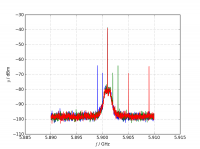
On 04/13/2015 05:50 AM, Sebastian Held via USRP-users wrote: > Update: > > I played around with the LO offset feature and got the following result: > > > The curves were generated by: > blue: ./tx_waveforms --args="master_clock_rate=10e6" --rate 10000000 > --freq=5900000000 --gain=50 --wave-type SINE --ref=gpsdo --int-n > --wave-freq=1000000 --lo_off=0 > green: ./tx_waveforms --args="master_clock_rate=10e6" --rate 10000000 > --freq=5900000000 --gain=50 --wave-type SINE --ref=gpsdo --int-n > --wave-freq=1000000 --lo_off=2000000 > red: ./tx_waveforms --args="master_clock_rate=10e6" --rate 10000000 > --freq=5900000000 --gain=50 --wave-type SINE --ref=gpsdo --int-n > --wave-freq=1000000 --lo_off=5000000 > > Clearly visible: The wanted sine (-38.9 dBm) is offset 1 MHz from 5.9 > GHz, which is correct. > The LO is the signal at -69.2 dBm; it moves according to the LO offset > parameter. > The to be rejected sideband is at -64.6 dBm. > > The specification of the B210 > (http://www.ettus.com/content/files/b200-b210_spec_sheet.pdf) states: > SSB/LO Suppression -35/50 dBc > > My measurement: > SSB/LO Suppression -25.7/30.3 dBc > > This is far off. > Does anyone have similar problems? > Is there anything I can do to improve these figures? > > Sebastian > What version of UHD are you using? Have you tried specifying a master clock rate that is a multiple of your (10Msps in your example) sample rate?
SH
Sebastian Held
Mon, Apr 13, 2015 1:33 PM

I updated my UHD today to the newest maint.

The problem was in fact the master clock rate. I had to change it from
the default, because of the sample rate. After that I forgot about it.
Increasing it to 40 MHz, my OFDM signals now pass the spetrum mask! (I
did not check with the sinusoids again, will do this tomorrow).

One problem remains: how to select the best master clock for a specific
sample rate?

Sebastian

Am 13.04.2015 um 15:24 schrieb Marcus D. Leech via USRP-users:

What version of UHD are you using?

Have you tried specifying a master clock rate that is a multiple of
your (10Msps in your example) sample rate?

--
Sebastian Held (Dipl.-Ing.)
IMST GmbH
Software Engineer

I updated my UHD today to the newest maint. The problem was in fact the master clock rate. I had to change it from the default, because of the sample rate. After that I forgot about it. Increasing it to 40 MHz, my OFDM signals now pass the spetrum mask! (I did not check with the sinusoids again, will do this tomorrow). One problem remains: how to select the best master clock for a specific sample rate? Sebastian Am 13.04.2015 um 15:24 schrieb Marcus D. Leech via USRP-users: > What version of UHD are you using? > > Have you tried specifying a master clock rate that is a multiple of > your (10Msps in your example) sample rate? -- Sebastian Held (Dipl.-Ing.) IMST GmbH Software Engineer
MD
Marcus D. Leech
Mon, Apr 13, 2015 1:49 PM

On 04/13/2015 09:33 AM, Sebastian Held wrote:

I updated my UHD today to the newest maint.

The problem was in fact the master clock rate. I had to change it from
the default, because of the sample rate. After that I forgot about it.
Increasing it to 40 MHz, my OFDM signals now pass the spetrum mask! (I
did not check with the sinusoids again, will do this tomorrow).

One problem remains: how to select the best master clock for a specific
sample rate?

Sebastian

Am 13.04.2015 um 15:24 schrieb Marcus D. Leech via USRP-users:

What version of UHD are you using?

Have you tried specifying a master clock rate that is a multiple of
your (10Msps in your example) sample rate?

Actually, in the latest UHD, if you don't specify a master clock rate,
UHD will pick an appropriate one.

On 04/13/2015 09:33 AM, Sebastian Held wrote: > I updated my UHD today to the newest maint. > > The problem was in fact the master clock rate. I had to change it from > the default, because of the sample rate. After that I forgot about it. > Increasing it to 40 MHz, my OFDM signals now pass the spetrum mask! (I > did not check with the sinusoids again, will do this tomorrow). > > One problem remains: how to select the best master clock for a specific > sample rate? > > Sebastian > > Am 13.04.2015 um 15:24 schrieb Marcus D. Leech via USRP-users: >> What version of UHD are you using? >> >> Have you tried specifying a master clock rate that is a multiple of >> your (10Msps in your example) sample rate? Actually, in the latest UHD, if you don't specify a master clock rate, UHD will pick an appropriate one.
IB
Ian Buckley
Mon, Apr 13, 2015 7:16 PM

So this this one has me curious. That image is way too big. I can reproduce it exactly using the same command line.
However when I use one of my standard GRC flow graphs to generate a CW with arbitrary LO/Offset etc the image is far better suppressed.
I see -40dBc vs -25dBc. I also see 10dB more power in the carrier with the same RF gain…that's with a digital CW from GR at 0.95 p-to-p amplitude.

I'm going to suggest that there is something in this UHD example thats less than ideal. I note that the code as supplied by Ettus has no "--lo_off" argument, so perhaps Sebastian has edited this example? Regardless I see the issue in the factory code and I'm going to file a bug.

To the observation that you are seeing improved improved spectral mask conformance with an OFDM signal…I suspect this is mostly because the recent update you did from maint caused you to pick up the new FPGA images that were published last week. These have specific filter changes to improve performance with exactly this kind of wideband signal.

The discussion of what is the ideal master_clock_rate vs what is merely an OK one is a very broad topic and differs between USRP's. If you want to give some specifics of your signal then I can give some suggestions.

On Apr 13, 2015, at 6:49 AM, Marcus D. Leech via USRP-users usrp-users@lists.ettus.com wrote:

On 04/13/2015 09:33 AM, Sebastian Held wrote:

I updated my UHD today to the newest maint.

The problem was in fact the master clock rate. I had to change it from
the default, because of the sample rate. After that I forgot about it.
Increasing it to 40 MHz, my OFDM signals now pass the spetrum mask! (I
did not check with the sinusoids again, will do this tomorrow).

One problem remains: how to select the best master clock for a specific
sample rate?

Sebastian

Am 13.04.2015 um 15:24 schrieb Marcus D. Leech via USRP-users:

What version of UHD are you using?

Have you tried specifying a master clock rate that is a multiple of
your (10Msps in your example) sample rate?

Actually, in the latest UHD, if you don't specify a master clock rate, UHD will pick an appropriate one.


USRP-users mailing list
USRP-users@lists.ettus.com
http://lists.ettus.com/mailman/listinfo/usrp-users_lists.ettus.com

So this this one has me curious. That image is way too big. I can reproduce it exactly using the same command line. *However* when I use one of my standard GRC flow graphs to generate a CW with arbitrary LO/Offset etc the image is far better suppressed. I see -40dBc vs -25dBc. I also see 10dB more power in the carrier with the same RF gain…that's with a digital CW from GR at 0.95 p-to-p amplitude. I'm going to suggest that there is something in this UHD example thats less than ideal. I note that the code as supplied by Ettus has no "--lo_off" argument, so perhaps Sebastian has edited this example? Regardless I see the issue in the factory code and I'm going to file a bug. To the observation that you are seeing improved improved spectral mask conformance with an OFDM signal…I suspect this is mostly because the recent update you did from maint caused you to pick up the new FPGA images that were published last week. These have specific filter changes to improve performance with exactly this kind of wideband signal. The discussion of what is the ideal master_clock_rate vs what is merely an OK one is a very broad topic and differs between USRP's. If you want to give some specifics of your signal then I can give some suggestions. On Apr 13, 2015, at 6:49 AM, Marcus D. Leech via USRP-users <usrp-users@lists.ettus.com> wrote: > On 04/13/2015 09:33 AM, Sebastian Held wrote: >> I updated my UHD today to the newest maint. >> >> The problem was in fact the master clock rate. I had to change it from >> the default, because of the sample rate. After that I forgot about it. >> Increasing it to 40 MHz, my OFDM signals now pass the spetrum mask! (I >> did not check with the sinusoids again, will do this tomorrow). >> >> One problem remains: how to select the best master clock for a specific >> sample rate? >> >> Sebastian >> >> Am 13.04.2015 um 15:24 schrieb Marcus D. Leech via USRP-users: >>> What version of UHD are you using? >>> >>> Have you tried specifying a master clock rate that is a multiple of >>> your (10Msps in your example) sample rate? > Actually, in the latest UHD, if you don't specify a master clock rate, UHD will pick an appropriate one. > > > _______________________________________________ > USRP-users mailing list > USRP-users@lists.ettus.com > http://lists.ettus.com/mailman/listinfo/usrp-users_lists.ettus.com
SH
Sebastian Held
Tue, Apr 14, 2015 6:08 AM

Dear Ian,

I'm going to suggest that there is something in this UHD example thats less than ideal. I note that the code as supplied by Ettus has no "--lo_off" argument, so perhaps Sebastian has edited this example? Regardless I see the issue in the factory code and I'm going to file a bug.

Yes, I modified the code code to include support for LO offset
modification (changed three lines or so - copied from an other example).
I did this, to nail down the cause of my problem.

To the observation that you are seeing improved improved spectral mask conformance with an OFDM signal…I suspect this is mostly because the recent update you did from maint caused you to pick up the new FPGA images that were published last week. These have specific filter changes to improve performance with exactly this kind of wideband signal.

Yes, you are right. By the way I'm on release_003_008_002-40-gf23e7bc.

The discussion of what is the ideal master_clock_rate vs what is merely an OK one is a very broad topic and differs between USRP's. If you want to give some specifics of your signal then I can give some suggestions.

My original problem was the violation of the spectrum mask for 802.11p
signals. I generate the IQ representation with a sample rate of 10 MHz.
Older UHD versions indicated a problem with the sample rate - from that
point on I used a fixed 10 MHz or 20 MHz master clock to further
invetigate the problem.

Back to my testcase: The sinusoids do not change if I modify the master
clock. There is certainly a problem with image suppression.
FYI: I attached the patch with the lo_off parameter. I could also file a
pull request if you wish.

Thanks
Sebastian

--

Sebastian Held (Dipl.-Ing.)
IMST GmbH
Softwareentwickler

Carl-Friedrich-Gauss-Str. 2-4
47475 Kamp-Lintfort
Tel: +49 2842 981-418
Fax: +49 2842 981-199
E-mail: mailto:sebastian.held@imst.de
Internet: http://www.imst.de

http://webshop.imst.de

Geschäftsführer:
Prof. Dr.-Ing. Ingo Wolff
Dr. Peter Waldow
Amtsgericht Kleve HRB 6737
USt.-ID: DE 811348335

Wir weisen darauf hin, dass rechtsverbindliche Erklärungen namens
unseres Hauses grundsätzlich der Unterschriften zweier ausreichend
bevollmächtigter Vertreter unseres Hauses bedürfen. Wir verschicken
daher keine rechtsverbindlichen Erklärungen per E-Mail an Dritte.
Demgemäß nehmen wir per E-Mail auch keine rechtsverbindlichen
Erklärungen oder Aufträge von Dritten entgegen. Diese E-Mail dient
einzig dem unverbindlichen Informationsaustausch zwischen Sender und
Empfänger. Sie entfaltet keine Rechtswirksamkeit.
Diese E-Mail ist vertraulich zu behandeln. Sollten Sie nicht der
vorgesehene Empfänger sein, bitten wir Sie, den Versender zu informieren
und die Nachricht zu löschen. Die Weitergabe sowie Vervielfältigung,
Verwertung und Mitteilung seines Inhalts ist nur mit unserer
ausdrücklichen Genehmigung gestattet. Alle Rechte vorbehalten,
insbesondere für den Fall der Schutzrechtsanmeldung.
This document has to be treated confidentially. If you are not the
intended recipient, please immediately notify the sender and delete this
message. Its contents are not to be passed on, duplicated, exploited or
disclosed without our expressed permission. All rights reserved,
especially the right to apply for protective rights.

Dear Ian, > I'm going to suggest that there is something in this UHD example thats less than ideal. I note that the code as supplied by Ettus has no "--lo_off" argument, so perhaps Sebastian has edited this example? Regardless I see the issue in the factory code and I'm going to file a bug. Yes, I modified the code code to include support for LO offset modification (changed three lines or so - copied from an other example). I did this, to nail down the cause of my problem. > To the observation that you are seeing improved improved spectral mask conformance with an OFDM signal…I suspect this is mostly because the recent update you did from maint caused you to pick up the new FPGA images that were published last week. These have specific filter changes to improve performance with exactly this kind of wideband signal. Yes, you are right. By the way I'm on release_003_008_002-40-gf23e7bc. > The discussion of what is the ideal master_clock_rate vs what is merely an OK one is a very broad topic and differs between USRP's. If you want to give some specifics of your signal then I can give some suggestions. My original problem was the violation of the spectrum mask for 802.11p signals. I generate the IQ representation with a sample rate of 10 MHz. Older UHD versions indicated a problem with the sample rate - from that point on I used a fixed 10 MHz or 20 MHz master clock to further invetigate the problem. Back to my testcase: The sinusoids do not change if I modify the master clock. There is certainly a problem with image suppression. FYI: I attached the patch with the lo_off parameter. I could also file a pull request if you wish. Thanks Sebastian -- Sebastian Held (Dipl.-Ing.) IMST GmbH Softwareentwickler Carl-Friedrich-Gauss-Str. 2-4 47475 Kamp-Lintfort Tel: +49 2842 981-418 Fax: +49 2842 981-199 E-mail: mailto:sebastian.held@imst.de Internet: http://www.imst.de http://webshop.imst.de Geschäftsführer: Prof. Dr.-Ing. Ingo Wolff Dr. Peter Waldow Amtsgericht Kleve HRB 6737 USt.-ID: DE 811348335 Wir weisen darauf hin, dass rechtsverbindliche Erklärungen namens unseres Hauses grundsätzlich der Unterschriften zweier ausreichend bevollmächtigter Vertreter unseres Hauses bedürfen. Wir verschicken daher keine rechtsverbindlichen Erklärungen per E-Mail an Dritte. Demgemäß nehmen wir per E-Mail auch keine rechtsverbindlichen Erklärungen oder Aufträge von Dritten entgegen. Diese E-Mail dient einzig dem unverbindlichen Informationsaustausch zwischen Sender und Empfänger. Sie entfaltet keine Rechtswirksamkeit. Diese E-Mail ist vertraulich zu behandeln. Sollten Sie nicht der vorgesehene Empfänger sein, bitten wir Sie, den Versender zu informieren und die Nachricht zu löschen. Die Weitergabe sowie Vervielfältigung, Verwertung und Mitteilung seines Inhalts ist nur mit unserer ausdrücklichen Genehmigung gestattet. Alle Rechte vorbehalten, insbesondere für den Fall der Schutzrechtsanmeldung. This document has to be treated confidentially. If you are not the intended recipient, please immediately notify the sender and delete this message. Its contents are not to be passed on, duplicated, exploited or disclosed without our expressed permission. All rights reserved, especially the right to apply for protective rights.
IB
Ian Buckley
Fri, Apr 17, 2015 12:10 AM

Sebastian,
We have a handle on this bug now, the AD9361's internal IQ Quadrature imbalance routine is not getting run at the correct time. The problem manifests in more than just this application and it will take a little time for us to push a full bug fix to UHD. Meantime if anyone feels this bug is affecting them then a workaround is to add a tune_request immediately before starting streaming to an LO frequency that differs by > 100MHz than the previous tune request, which will force the IQ Quad Cal to re-run. When I try that workaround in tx_waveforms I see the image drop from -25dBc to > -40dBc in your 5.9GHz case, and > -50dBc when run at 4.9GHz.

-Ian

diff --git a/host/examples/tx_waveforms.cpp b/host/examples/tx_waveforms.cpp
index 7e63326..eb64d7b 100644
--- a/host/examples/tx_waveforms.cpp
+++ b/host/examples/tx_waveforms.cpp
@@ -170,11 +170,11 @@ int UHD_SAFE_MAIN(int argc, char *argv[]){
}

 for(size_t ch = 0; ch < channel_nums.size(); ch++) {
  •    std::cout << boost::format("Setting TX Freq: %f MHz...") % (freq/1e6) << std::endl;
    
  •    uhd::tune_request_t tune_request(freq);
    
  •    if(vm.count("int-n")) tune_request.args = uhd::device_addr_t("mode_n=integer");
    
  •    usrp->set_tx_freq(tune_request, channel_nums[ch]);
    
  •    std::cout << boost::format("Actual TX Freq: %f MHz...") % (usrp->get_tx_freq(channel_nums[ch])/1e6) << std::endl << std::endl;
    
  •  //     std::cout << boost::format("Setting TX Freq: %f MHz...") % (freq/1e6) << std::endl;
    
  •  //     uhd::tune_request_t tune_request(freq);
    
  •  //     if(vm.count("int-n")) tune_request.args = uhd::device_addr_t("mode_n=integer");
    
  •  //     usrp->set_tx_freq(tune_request, channel_nums[ch]);
    
  •  //     std::cout << boost::format("Actual TX Freq: %f MHz...") % (usrp->get_tx_freq(channel_nums[ch])/1e6) << std::endl << std::endl;
    
       //set the rf gain
       if (vm.count("gain")){
    

@@ -255,6 +255,10 @@ int UHD_SAFE_MAIN(int argc, char *argv[]){
UHD_ASSERT_THROW(ref_locked.to_bool());
}

  • uhd::tune_request_t tune_request(freq);
  • if(vm.count("int-n")) tune_request.args = uhd::device_addr_t("mode_n=integer");
  • usrp->set_tx_freq(tune_request, channel_nums[0]);
  • std::signal(SIGINT, &sig_int_handler);
    std::cout << "Press Ctrl + C to stop streaming..." << std::endl;

On Apr 13, 2015, at 11:08 PM, Sebastian Held sebastian.held@imst.de wrote:

Dear Ian,

I'm going to suggest that there is something in this UHD example thats less than ideal. I note that the code as supplied by Ettus has no "--lo_off" argument, so perhaps Sebastian has edited this example? Regardless I see the issue in the factory code and I'm going to file a bug.

Yes, I modified the code code to include support for LO offset modification (changed three lines or so - copied from an other example). I did this, to nail down the cause of my problem.

To the observation that you are seeing improved improved spectral mask conformance with an OFDM signal…I suspect this is mostly because the recent update you did from maint caused you to pick up the new FPGA images that were published last week. These have specific filter changes to improve performance with exactly this kind of wideband signal.

Yes, you are right. By the way I'm on release_003_008_002-40-gf23e7bc.

The discussion of what is the ideal master_clock_rate vs what is merely an OK one is a very broad topic and differs between USRP's. If you want to give some specifics of your signal then I can give some suggestions.

My original problem was the violation of the spectrum mask for 802.11p signals. I generate the IQ representation with a sample rate of 10 MHz. Older UHD versions indicated a problem with the sample rate - from that point on I used a fixed 10 MHz or 20 MHz master clock to further invetigate the problem.

Back to my testcase: The sinusoids do not change if I modify the master clock. There is certainly a problem with image suppression.
FYI: I attached the patch with the lo_off parameter. I could also file a pull request if you wish.

Thanks
Sebastian

--
Sebastian Held (Dipl.-Ing.)
IMST GmbH
Softwareentwickler

Carl-Friedrich-Gauss-Str. 2-4
47475 Kamp-Lintfort
Tel: +49 2842 981-418
Fax: +49 2842 981-199
E-mail: mailto:sebastian.held@imst.de
Internet: http://www.imst.de

http://webshop.imst.de

Geschäftsführer:
Prof. Dr.-Ing. Ingo Wolff
Dr. Peter Waldow
Amtsgericht Kleve HRB 6737
USt.-ID: DE 811348335

Wir weisen darauf hin, dass rechtsverbindliche Erklärungen namens unseres Hauses grundsätzlich der Unterschriften zweier ausreichend bevollmächtigter Vertreter unseres Hauses bedürfen. Wir verschicken daher keine rechtsverbindlichen Erklärungen per E-Mail an Dritte. Demgemäß nehmen wir per E-Mail auch keine rechtsverbindlichen Erklärungen oder Aufträge von Dritten entgegen. Diese E-Mail dient einzig dem unverbindlichen Informationsaustausch zwischen Sender und Empfänger. Sie entfaltet keine Rechtswirksamkeit.
Diese E-Mail ist vertraulich zu behandeln. Sollten Sie nicht der vorgesehene Empfänger sein, bitten wir Sie, den Versender zu informieren und die Nachricht zu löschen. Die Weitergabe sowie Vervielfältigung, Verwertung und Mitteilung seines Inhalts ist nur mit unserer ausdrücklichen Genehmigung gestattet. Alle Rechte vorbehalten, insbesondere für den Fall der Schutzrechtsanmeldung.
This document has to be treated confidentially. If you are not the intended recipient, please immediately notify the sender and delete this message. Its contents are not to be passed on, duplicated, exploited or disclosed without our expressed permission. All rights reserved, especially the right to apply for protective rights.

<0001-added-lo_off-parameter-to-tx_waveforms-example.patch>

Sebastian, We have a handle on this bug now, the AD9361's internal IQ Quadrature imbalance routine is not getting run at the correct time. The problem manifests in more than just this application and it will take a little time for us to push a full bug fix to UHD. Meantime if anyone feels this bug is affecting them then a workaround is to add a tune_request immediately before starting streaming to an LO frequency that differs by > 100MHz than the previous tune request, which will force the IQ Quad Cal to re-run. When I try that workaround in tx_waveforms I see the image drop from -25dBc to > -40dBc in your 5.9GHz case, and > -50dBc when run at 4.9GHz. -Ian diff --git a/host/examples/tx_waveforms.cpp b/host/examples/tx_waveforms.cpp index 7e63326..eb64d7b 100644 --- a/host/examples/tx_waveforms.cpp +++ b/host/examples/tx_waveforms.cpp @@ -170,11 +170,11 @@ int UHD_SAFE_MAIN(int argc, char *argv[]){ } for(size_t ch = 0; ch < channel_nums.size(); ch++) { - std::cout << boost::format("Setting TX Freq: %f MHz...") % (freq/1e6) << std::endl; - uhd::tune_request_t tune_request(freq); - if(vm.count("int-n")) tune_request.args = uhd::device_addr_t("mode_n=integer"); - usrp->set_tx_freq(tune_request, channel_nums[ch]); - std::cout << boost::format("Actual TX Freq: %f MHz...") % (usrp->get_tx_freq(channel_nums[ch])/1e6) << std::endl << std::endl; + // std::cout << boost::format("Setting TX Freq: %f MHz...") % (freq/1e6) << std::endl; + // uhd::tune_request_t tune_request(freq); + // if(vm.count("int-n")) tune_request.args = uhd::device_addr_t("mode_n=integer"); + // usrp->set_tx_freq(tune_request, channel_nums[ch]); + // std::cout << boost::format("Actual TX Freq: %f MHz...") % (usrp->get_tx_freq(channel_nums[ch])/1e6) << std::endl << std::endl; //set the rf gain if (vm.count("gain")){ @@ -255,6 +255,10 @@ int UHD_SAFE_MAIN(int argc, char *argv[]){ UHD_ASSERT_THROW(ref_locked.to_bool()); } + uhd::tune_request_t tune_request(freq); + if(vm.count("int-n")) tune_request.args = uhd::device_addr_t("mode_n=integer"); + usrp->set_tx_freq(tune_request, channel_nums[0]); + std::signal(SIGINT, &sig_int_handler); std::cout << "Press Ctrl + C to stop streaming..." << std::endl; On Apr 13, 2015, at 11:08 PM, Sebastian Held <sebastian.held@imst.de> wrote: > Dear Ian, > >> I'm going to suggest that there is something in this UHD example thats less than ideal. I note that the code as supplied by Ettus has no "--lo_off" argument, so perhaps Sebastian has edited this example? Regardless I see the issue in the factory code and I'm going to file a bug. > Yes, I modified the code code to include support for LO offset modification (changed three lines or so - copied from an other example). I did this, to nail down the cause of my problem. >> To the observation that you are seeing improved improved spectral mask conformance with an OFDM signal…I suspect this is mostly because the recent update you did from maint caused you to pick up the new FPGA images that were published last week. These have specific filter changes to improve performance with exactly this kind of wideband signal. > Yes, you are right. By the way I'm on release_003_008_002-40-gf23e7bc. >> The discussion of what is the ideal master_clock_rate vs what is merely an OK one is a very broad topic and differs between USRP's. If you want to give some specifics of your signal then I can give some suggestions. > My original problem was the violation of the spectrum mask for 802.11p signals. I generate the IQ representation with a sample rate of 10 MHz. Older UHD versions indicated a problem with the sample rate - from that point on I used a fixed 10 MHz or 20 MHz master clock to further invetigate the problem. > > > Back to my testcase: The sinusoids do not change if I modify the master clock. There is certainly a problem with image suppression. > FYI: I attached the patch with the lo_off parameter. I could also file a pull request if you wish. > > Thanks > Sebastian > > > > -- > Sebastian Held (Dipl.-Ing.) > IMST GmbH > Softwareentwickler > > Carl-Friedrich-Gauss-Str. 2-4 > 47475 Kamp-Lintfort > Tel: +49 2842 981-418 > Fax: +49 2842 981-199 > E-mail: mailto:sebastian.held@imst.de > Internet: http://www.imst.de > > http://webshop.imst.de > > Geschäftsführer: > Prof. Dr.-Ing. Ingo Wolff > Dr. Peter Waldow > Amtsgericht Kleve HRB 6737 > USt.-ID: DE 811348335 > > Wir weisen darauf hin, dass rechtsverbindliche Erklärungen namens unseres Hauses grundsätzlich der Unterschriften zweier ausreichend bevollmächtigter Vertreter unseres Hauses bedürfen. Wir verschicken daher keine rechtsverbindlichen Erklärungen per E-Mail an Dritte. Demgemäß nehmen wir per E-Mail auch keine rechtsverbindlichen Erklärungen oder Aufträge von Dritten entgegen. Diese E-Mail dient einzig dem unverbindlichen Informationsaustausch zwischen Sender und Empfänger. Sie entfaltet keine Rechtswirksamkeit. > Diese E-Mail ist vertraulich zu behandeln. Sollten Sie nicht der vorgesehene Empfänger sein, bitten wir Sie, den Versender zu informieren und die Nachricht zu löschen. Die Weitergabe sowie Vervielfältigung, Verwertung und Mitteilung seines Inhalts ist nur mit unserer ausdrücklichen Genehmigung gestattet. Alle Rechte vorbehalten, insbesondere für den Fall der Schutzrechtsanmeldung. > This document has to be treated confidentially. If you are not the intended recipient, please immediately notify the sender and delete this message. Its contents are not to be passed on, duplicated, exploited or disclosed without our expressed permission. All rights reserved, especially the right to apply for protective rights. > > <0001-added-lo_off-parameter-to-tx_waveforms-example.patch>