

usrp-users@lists.ettus.com
Discussion and technical support related to USRP, UHD, RFNoC
View all threadsFW: SBX RF board simultaneous mode with USRP Hardware Support for MATLAB

Hello USRP Users,
Together with the MathWorks, I have been investigating an RF loop back
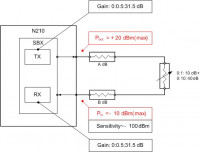
configuration comprised of an N210 USRP and an SBX RF board as shown in the
block diagram below.
The diagram above shows two fixed attenuators (with attenuations of A dB and
B dB) and a variable stepped attenuator with a range of 0 to 50 dB in 1 dB
steps. Maximum Tx output and maximum Rx input signal levels are also
included in the diagram together with details of the receiver sensitivity
and the gain ranges of the Tx and Rx blocks.
To ensure that the gain settings and attenuator values will result in an RF
signal level that will a) not cause damage to the RF front end and b) will
still allow adequate Rx dynamic range, the following calculation was made:
Assume
i) The gain of both the Tx and Rx blocks is set to the maximum of 31.5 dB
ii) Two fixed attenuators of 30 dB each and a variable attenuator setting of
0 dB
Then the power level at the RX input port (RF2) will be:
Pin = Pout - 30 dB - 0 dB - 30 dB
Pin = 20 dBm - 60 dB
Pin = -40 dBm
With reference to the values shown in the figure above, this is 30 dB below
the maximum input level and 60 dB above the sensitivity (or minimum input)
level of the Rx front end.
A Windows XP PC was used to control the N210/SBX running MATLAB R2012a
together with the required USRP support toolboxes. The R2012a USRP library
uses UHD 003.002.003.
Attached to this e-mail are a MATLAB script and its complementary Simulink
model. The operation of the former is presented here. During the first half
of the simulation, a 60 kHz sinusoidal source is set to an amplitude level
of 0.1, while in the second half of the simulation, this level is reduced to
0.001 (i.e., a 40 dB reduction). The gain of both the SDRu_Tx and the
SDRu_Rx is set to 20 dB. Similarly, a carrier frequency of 915 MHz is used
for both the SDRu_Tx and the SDRu_Rx blocks. A CW signal is transmitted.
During execution of the loop, the spectrum of the received baseband signal
is plotted. This allows the amplitude of the ± 60 kHz peaks to be observed
for both the first and second half of the execution loop. Such measurements
were recorded for various RF attenuator settings. These are recorded in the
table below (the RF attenuation refers to the sum of the two fixed
attenuators plus the variable attenuator):
Measurement
RF attenuation
Spectral Levels
1
60 dB
-54 dB, then -94 dB
2
70 dB
-54 dB, then -94 dB
3
80 dB
-54 dB, then -94 dB
4
100 dB
-54 dB, then -94 dB
The table shows that the spectral levels were not affected by the setting of
the RF attenuation in the loop back path.
Similar measurements were made by the MathWorks using the same MATLAB script
and an additional Simulink model (but with different hardware). These are
presented below:
Platform
Attenuators
Spectral Levels
MATLAB
30 dB + 10 dB = 40 dB
-57 dB, then -98 dB
30 dB + 30 dB = 60 dB
-58 dB, then -99 dB
Simulink
30 dB + 10 dB = 40 dB
-57 dB
30 dB + 30 dB = 60 dB
-58 dB
Again, the table above shows that the spectral levels were not affected by
the setting of the RF attenuation in the loop back path.
Further measurements were made in which the amplitude of the sinusoidal
source was varied, details of which and the results obtained are presented
as follows:
Scenario 1
usrpfdplx.USRPGain = 20
usrpfdplx.SineAmplitude = 0.1
hSineSource.Amplitude = 0.001
amplitude peaks at -54 dB/Hz, then drops to -94 dB/Hz
Scenario 2
usrpfdplx.USRPGain = 20
usrpfdplx.SineAmplitude = 0.01
hSineSource.Amplitude = 1e-4
amplitude peaks at -75 dB/Hz, then drops to -118 dB/Hz
Reducing the amplitude of the input sine wave from 0.1 to 0.01 reduces its
power by 20 dB. This change is seen in the spectral levels. However, as
before, the spectral levels were not affected by the attenuation of the RF
loop back path.
It should be noted that the same frequency is being used for both the
transmit and receive chains and that both are required to operate
simultaneously. Although this would be unusual in a communication system
(where normally frequency division duplex would be used), it is however
common practice for a variety of measurement scenarios including those of
that characterize the propagation channel.
Please explain why the spectral levels are not affected by the setting of
the RF attenuation in the loop back or otherwise comment on the very
detailed information presented above.
With many thanks (in advance),
Stan
PS Thanks to the MathWorks for your off-list support.

Hello USRP Users,
Please explain why the spectral levels are not affected by the
setting of the RF attenuation in the loop back or otherwise comment
on the very detailed information presented above.
With many thanks (in advance),
Stan
PS Thanks to the MathWorks for your off-list support.
My initial guess is that the TX-to-RX isolation is not infinite. It's
somewhere around 45-50dB. So for high attenuation levels, the external loop
back simply doesn't have much effect.
There are (trivial) hardware mods one can do to improve TX-to-RX
isolation, but they have the effect of making half-duplex-via-TX/RX port
no longer work--the TX/RX port becomes a TX port only. If this is
OK, please contact support@ettus.com for more details.
--
Marcus Leech
Principal Investigator
Shirleys Bay Radio Astronomy Consortium
http://www.sbrac.org