

usrp-users@lists.ettus.com
Discussion and technical support related to USRP, UHD, RFNoC
View all threadsLong period, low-amplitude noise burst in receive during active TDMA operation (B200mini)

Hi All,
I have built a TDMA system that uses the B200mini. In doing a simple test to look at processing load for transceiver operation (B200mini transmits when it is told, otherwise is receiving), I noticed an interesting effect.
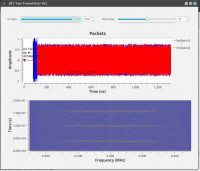
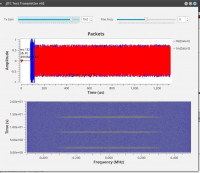
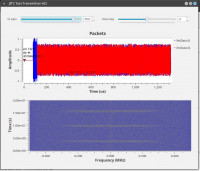
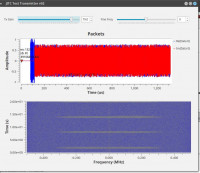
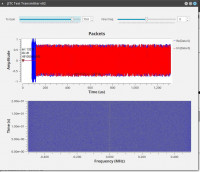
When the transmit and receive carrier frequencies are the same (below, 100 MHz), every 5 seconds or so (but periodic) a slow-amplitude burst signal appears on the receive channel. The is no active transmission for that channel. Indeed, when contigured with transmit on TRX and receive on RX2, there isn’t even an antenna on the RX2.
I first noticed the “noise” on a time sink, but the waterfall makes it easy to see the periodicity.
Packets are transmitted at 100 packets/second and are ~1300 us in duration (fixed).
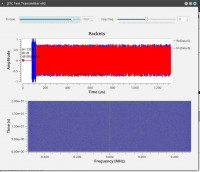
I include some images below for consideration. The “Packets” display is the transmitted signal. The received noise burst amplitude is proportional to the transmit gain, and it quite low, but not insignificant.
Anyone seen this?
To anticipate one question, no, I have not used a different B200mini to see if it’s hardware, but the fact that I don’t see it at 900 MHz receive makes me think it is not.
Figure 1 B200mini Tx and Rx using TRX port only, fTX = fRX = 100 MHz
Figure 2 B200mini Tx using TRX port, Rx using Rx2 port, fTX = fRX = 100 MHz
Figure 3 B200mini Tx using TRX port, Rx using Rx2 port, fTX = 100 MHz fRX = 900 MHz
Steven Knudsen, Ph.D., P.Eng.
www. techconficio.ca http://techconficio.ca/
www.linkedin.com/in/knudstevenknudsen http://www.linkedin.com/in/knudstevenknudsen
So fest wie die Hand den Stein hält. Sie hält ihn aber fest, nur um ihn desto weiter zu verwerfen. Aber auch in jene Weite führt der Weg. - Franz Kafka
Steven Knudsen, Ph.D., P.Eng.
www. techconficio.ca http://techconficio.ca/
www.linkedin.com/in/knudstevenknudsen http://www.linkedin.com/in/knudstevenknudsen
Du bist die Aufgabe. Kein Schüler weit und breit. - Franz Kafka

Steve:
Just saw this now. Have you been able to resolve this yourself, or is
this still a problem?
What if you put terminators on both TX/RX and RX2 ports, do you still
see these regular, low-amplitude "bursts" every few seconds?
On 09/29/2016 11:34 AM, Steven Knudsen via USRP-users wrote:
Hi All,
I have built a TDMA system that uses the B200mini. In doing a simple
test to look at processing load for transceiver operation (B200mini
transmits when it is told, otherwise is receiving), I noticed an
interesting effect.
When the transmit and receive carrier frequencies are the same (below,
100 MHz), every 5 seconds or so (but periodic) a slow-amplitude burst
signal appears on the receive channel. The is no active transmission
for that channel. Indeed, when contigured with transmit on TRX and
receive on RX2, there isn’t even an antenna on the RX2.
I first noticed the “noise” on a time sink, but the waterfall makes it
easy to see the periodicity.
Packets are transmitted at 100 packets/second and are ~1300 us in
duration (fixed).
I include some images below for consideration. The “Packets” display
is the transmitted signal. The received noise burst amplitude is
proportional to the transmit gain, and it quite low, but not
insignificant.
Anyone seen this?
To anticipate one question, no, I have not used a different B200mini
to see if it’s hardware, but the fact that I don’t see it at 900 MHz
receive makes me think it is not.
Figure 1 B200mini Tx and Rx using TRX port only, f_TX = f_RX = 100 MHz
Figure 2 B200mini Tx using TRX port, Rx using Rx2 port, f_TX = f_RX
= 100 MHz
Figure 3 B200mini Tx using TRX port, Rx using Rx2 port, f_TX = 100
MHz f_RX = 900 MHz
Steven Knudsen, Ph.D., P.Eng.
www.techconficio.ca http://techconficio.ca
www.linkedin.com/in/knudstevenknudsen
http://www.linkedin.com/in/knudstevenknudsen
So fest wie die Hand den Stein hält. Sie hält ihn aber fest, nur um
ihn desto weiter zu verwerfen. Aber auch in jene Weite führt der
Weg./- Franz Kafka/
No problem, Marcus.
I still see this effect, but your idea is a great one (I should have tried it), so I will try and get back to you and the list.
However, I think you are wondering about cross-channel coupling, which is always a possibility. The thing I don’t understand is the very long period. The only thing I can think of is the 1 PPS counter cycle (the so-called sawtooth effect) that is illustrated here [1] http://www.leapsecond.com/pages/vp/heater.htm. That may have something to do with it as the sawtooth period can sometimes be long (it all depends on the receiver module implementation). However, I’m not too hopeful about that theory… Obviously, I will disconnect the 1 PPS ref and see what happens.
[1] http://www.leapsecond.com/pages/vp/heater.htm http://www.leapsecond.com/pages/vp/heater.htm
Steven Knudsen, Ph.D., P.Eng.
www. techconficio.ca
www.linkedin.com/in/knudstevenknudsen
Der entscheidende Augenblick der menschlichen Entwicklung ist immerwährend. Darum sind die revolutionären geistigen Bewegungen, welche alles Frühere für nichtig erklären, im Recht, denn es ist noch nichts geschehen. - Franz Kafka
On Oct 10, 2016, at 18:10, Marcus D. Leech via USRP-users usrp-users@lists.ettus.com wrote:
Steve:
Just saw this now. Have you been able to resolve this yourself, or is this still a problem?
What if you put terminators on both TX/RX and RX2 ports, do you still see these regular, low-amplitude "bursts" every few seconds?
On 09/29/2016 11:34 AM, Steven Knudsen via USRP-users wrote:
Hi All,
I have built a TDMA system that uses the B200mini. In doing a simple test to look at processing load for transceiver operation (B200mini transmits when it is told, otherwise is receiving), I noticed an interesting effect.
When the transmit and receive carrier frequencies are the same (below, 100 MHz), every 5 seconds or so (but periodic) a slow-amplitude burst signal appears on the receive channel. The is no active transmission for that channel. Indeed, when contigured with transmit on TRX and receive on RX2, there isn’t even an antenna on the RX2.
I first noticed the “noise” on a time sink, but the waterfall makes it easy to see the periodicity.
Packets are transmitted at 100 packets/second and are ~1300 us in duration (fixed).
I include some images below for consideration. The “Packets” display is the transmitted signal. The received noise burst amplitude is proportional to the transmit gain, and it quite low, but not insignificant.
Anyone seen this?
To anticipate one question, no, I have not used a different B200mini to see if it’s hardware, but the fact that I don’t see it at 900 MHz receive makes me think it is not.
Figure 1 B200mini Tx and Rx using TRX port only, fTX = fRX = 100 MHz
<Mail Attachment.jpeg>
Figure 2 B200mini Tx using TRX port, Rx using Rx2 port, fTX = fRX = 100 MHz
<Mail Attachment.jpeg>
Figure 3 B200mini Tx using TRX port, Rx using Rx2 port, fTX = 100 MHz fRX = 900 MHz
<Mail Attachment.jpeg>
Steven Knudsen, Ph.D., P.Eng.
www. techconficio.ca http://techconficio.ca/
www.linkedin.com/in/knudstevenknudsen http://www.linkedin.com/in/knudstevenknudsen
So fest wie die Hand den Stein hält. Sie hält ihn aber fest, nur um ihn desto weiter zu verwerfen. Aber auch in jene Weite führt der Weg. - Franz Kafka
USRP-users mailing list
USRP-users@lists.ettus.com
http://lists.ettus.com/mailman/listinfo/usrp-users_lists.ettus.com